Home > Aquilino Ribeiro
Aquilino Ribeiro
13th September, 1885 (Viseu, Portugal) – 27th May, 1963 (Lisbon, Portugal)
We celebrate Aquilino Ribeiro in our luxury boutique hotel, in the center of Porto.
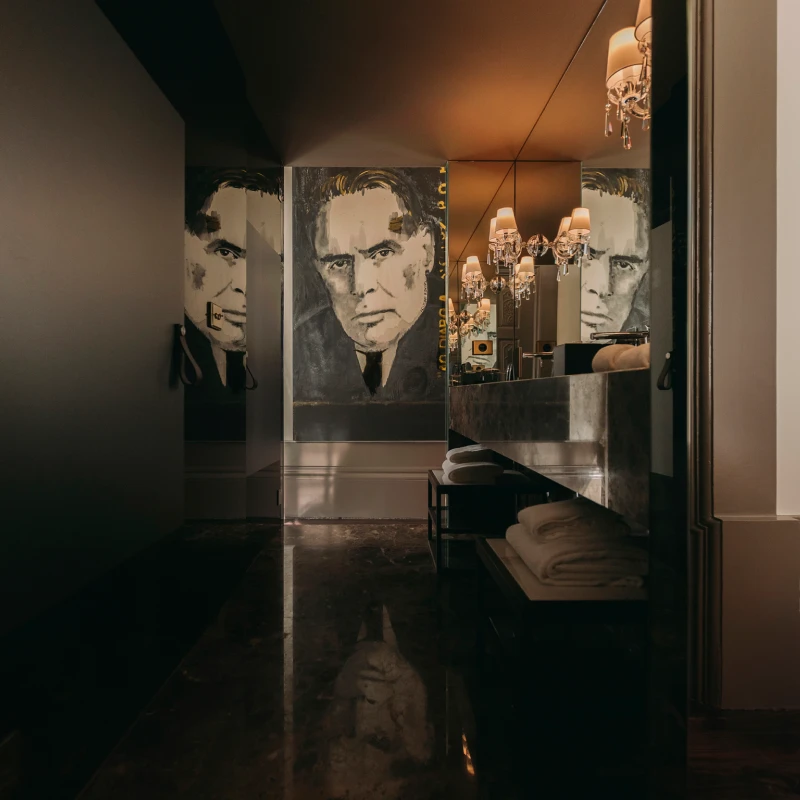
In our Torel Palace Porto, we booked this author a hotel room in the Suite Junior category, with a twin bed and city view. The room, decorated by the designer Isabel Sá Nogueira, is a spacious room based on the second floor. The portrait of the author is a creation of Jorge Curval.
The marble-decorated bathroom goes unnoticed, despite being in the middle of the room inside a giant cube, completely lined with a mirror.
- Up to 2 People
- 40 m2
- Double or Twin Bed
- Coffee Machine
- Mini Bar
- Television
- Free WiFi
- Air Conditioning
- Hairdryer
- Safe


About...
Aquilino Gomes Ribeiro was a Portuguese writer and considered one of the most versatile Portuguese novelists.
Some of her main works:
Garden of Storms (1913)
Lands of the Devil (1919)
The Romance of the Fox (1929)
When Wolves Howl (1958)
“When I started to make a name for myself in the world, my nobles, life was just another drug.” – The Little Wigglers, Aquilino Ribeiro.
The domains covered range from novels to short stories, ethnographic and historical studies, biography, children’s literature, and controversial journalism.
Aquilino joined the republican movement, having been arrested and fled the country more than once, to France and Germany. It was when he fled to Paris that he wrote his first book, Jardim das Tormentas. His motto throughout his life was “Reach those who never tire”.
In 1956, he was elected the first president of the Portuguese Writers Association.
In 1963, when he was preparing to be honored at a national level, he died suddenly. Today, he is buried in the National Pantheon, in Lisbon, a decision taken by the Assembly of the Republic as a way of honoring his memory. “I couldn’t do it anymore”, was the epitaph chosen by the writer.nosed with pulmonary edema, dying on her 36th birthday from an overdose.
Due to the use of popular expressions and expressions that are less (or not at all) common today, Aquilino’s language was considered challenging. Therefore, the Center for Aquilinian Studies created an Aquilinian Glossary, to facilitate the reading of his works.